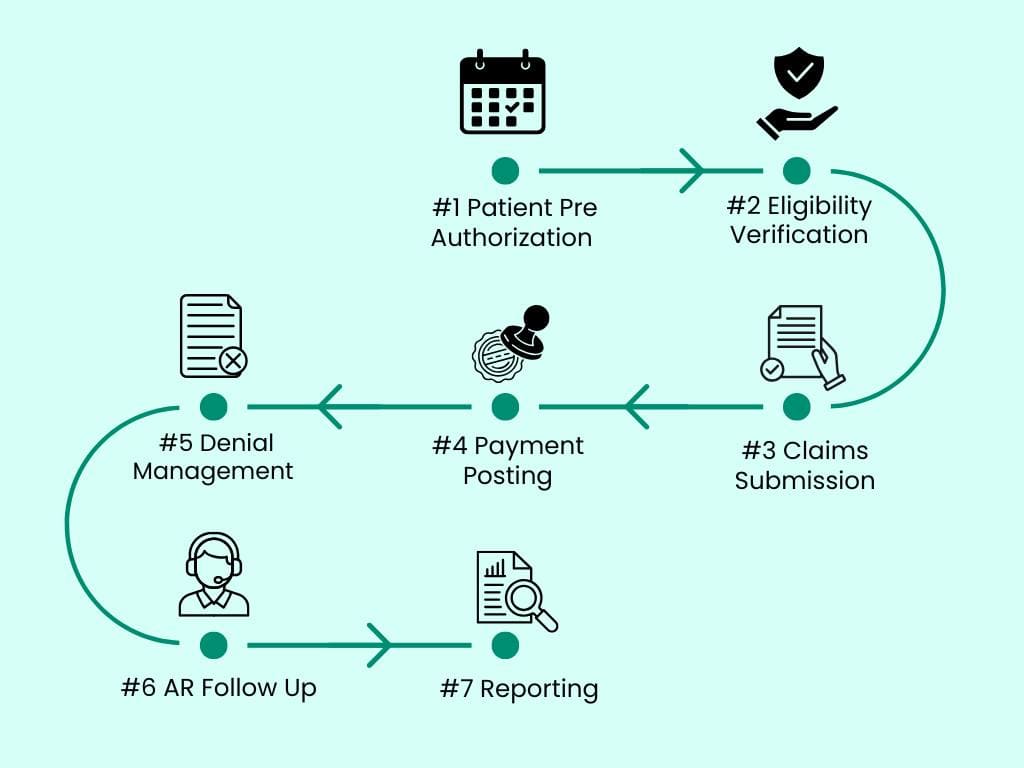
For the modern U.S. medical practice, Revenue Cycle Management (RCM) is no longer a “back-office” function. In 2026, it is the financial central nervous system of your business. With the CMS-0057-F Final Rule now fully in effect, and with patient costs at record highs, old billing methods no longer work. If your practice is experiencing a “leak” in its bottom line, the culprit is likely a fragmented revenue cycle.
This guide gives a clear, strategic look at Revenue Cycle Management. It explains how AI has changed it over time. It also shows how to improve each touchpoint, from the first patient call to final payment.
➤ What is Revenue Cycle Management (RCM) in 2026?
At its core, Revenue Cycle Management (RCM) is the financial process healthcare facilities use to track patient care.
It covers each episode from registration and appointment scheduling to final balance payment.
However, in the current U.S. landscape, RCM in medical billing has shifted. It is now a data-driven field.
It uses automation to link clinical notes with financial reimbursement. The goal is simple: ensure the practice receives the full contract rate for every service it provides. It should happen as quickly as possible, with minimal administrative friction.
➤ Why Healthcare RCM is the “Tipping Point” for Private Practices
In 2026, practices face a “perfect storm”:
- ➤ Medicare Fee Reductions: The 2026 Physician Fee Schedule continues to squeeze margins.
- ➤ Complexity: New ICD-10 codes and SDoH (Social Determinants of Health) modifiers require extreme specificity.
- ➤ The Staffing Crisis: Certified coder vacancies are at an all-time high, making manual billing unsustainable.
➤ The Strategic 2026 RCM Framework: A Step-by-Step Guide
Effective Revenue Cycle Management in healthcare is divided into three critical phases: Front-End, Mid-Cycle, and Back-End.
1. Front-End: Precision at the Digital Front Door
Over 30% of claim denials originate at the front desk. In 2026, top practices use AI-based eligibility checks. These checks stop errors before the doctor sees the patient.
- ➤ Real-Time Eligibility (RTE): Verification must happen 48 hours before the visit and again at check-in.
- ➤ Prior Authorization Automation: Under the new CMS rules, payers must now provide standard prior auth decisions within 7 days. Your RCM system should automatically flag these requirements to prevent “No Auth” denials.
- ➤ The No Surprises Act: Your front-end team must provide Good Faith Estimates (GFEs) to uninsured or self-pay patients to remain compliant.
2. Mid-Cycle: Documentation and Autonomous Coding
This is where clinical care is translated into revenue.
- ➤Clinical Documentation Improvement (CDI): Doctors must document for “medical necessity.” If the chart doesn’t support the level of service, the claim will fail.
- ➤Autonomous Coding: 2026 marks the move away from human-only coding. AI-driven agentic systems now review physician notes in real time. They suggest the most accurate CPT and ICD-10 codes. This can cut human error by up to 80%.
3. Back-End: Predictive Denial Management
The back-end is no longer about just “mailing statements.”
- ➤Claim Scrubbing: Before you send a claim to the payer, run it through an advanced scrubbing engine. The engine checks it against payer rules for 2026.
- ➤Predictive Analytics: Today’s RCM tools predict which claims may be denied by learning from past payer patterns. This helps your staff fix issues before filing.
- ➤Patient Financial Engagement: Patient-paid balances now make up almost 30% of practice income. Digital payment plans and “One Big Beautiful Bill” (OBBBA) compliance are key. They help improve collections.
➤ Critical 2026 Regulatory Updates: What Doctors Must Know
➤ CMS-0057-F Interoperability & Prior Auth Rule
Starting in 2026, CMS mandates that payers implement electronic prior authorization (ePA) APIs. This is a big win for practices. It lets your RCM software talk directly to payers. It cuts the admin burden that has hurt physicians for decades.
➤Value-Based Care (VBC) Integration
The shift from “volume to value” is accelerating. Your RCM strategy must now track quality metrics alongside RVUs (Relative Value Units). If your system isn’t capturing “outcomes data,” you are likely missing out on shared savings and incentive payments.
➤ The “Yield-First” KPI Dashboard: Benchmarking for Success
If you aren’t measuring your revenue cycle, you can’t manage it. Monitor these four “Gold Standard” metrics for 2026:
| Metric | 2026 Benchmark | Why It Matters |
|---|---|---|
| Days in A/R | < 35 Days | Measures how fast you convert services to cash. |
| Clean Claim Rate | > 95% | The percentage of claims paid on the first submission. |
| Net Collection Rate | > 96% | The ultimate measure of how much "collectible" money you keep. |
| Denial Rate | < 5% | High rates indicate systemic issues in coding or front-end verification. |
➤ ROI Analysis: The Cost of Inaction
Many practice owners hesitate to upgrade their RCM because of the initial software cost. However, the cost of manual RCM is far higher:
- ➤Rework Costs: It costs approximately $118 per claim to appeal and rework a denial.
- ➤Revenue Leakage: The average practice loses 5% to 10% of annual revenue due to underpayments missed by manual systems.
- ➤Labor Savings: Using AI-driven RCM can cut admin labor costs by 30-45%. It lets staff focus on patient care, not chasing lost claims.
➤ Common RCM Pitfalls to Avoid in 2026
- ➤Treating Payer Contracts as Static: Payer rates change. If you are not auditing payments against your contracted rates, you may be underpaid by 3–5% on each claim.
- ➤Ignoring the “Medicaid Unwinding”: In 2025–2026, 10 million Americans may lose Medicaid coverage. If you do not re-verify insurance at every visit, you risk bad debt.
- ➤Fragmented Workflows: Using a different system for scheduling, EHR, and billing creates data silos. ➤Integrated RCM is the only way to ensure data integrity.
➤ Frequestly Asked Questions (FAQS)
1. What is revenue cycle management in healthcare?
Revenue cycle management (RCM) is the full financial process that hospitals and clinics use to get paid for their services. It starts when a patient books an appointment and ends when the provider receives all payments from insurance or the patient.
2. How does revenue cycle management work?
After treatment, the services are recorded and turned into standard medical codes. These codes are sent to insurance as claims. Once the claim is processed, the payment is recorded and any remaining balance is sent to the patient. If a claim is denied, it is corrected and resubmitted.
3. Why is revenue cycle management important in healthcare?
Revenue cycle management crucial because it ensures that providers receive accurate, timely payments. Without an efficient system, delays, denials, and financial losses can cripple operations. A strong revenue cycle management keeps the organization financially stable so staff can focus on patient care.
4. How can an organization improve its revenue cycle management?
Improvements include:
– Strengthening patient registration and insurance verification before services.
– Enhancing documentation accuracy and reducing coding errors.
– Providing regular staff training and monitoring performance.
– Using automation tools to cut denials and speed up payments.
5. How to improve revenue cycle management in healthcare overall?
A proactive strategy works best:
– Analyze denial trends and key financial metrics.
– Streamline workflows and improve communication between clinical and billing teams.
– Invest in modern revenue cycle management software.
– Enhance the patient billing experience to boost collections and cash flow.