Skip to main content
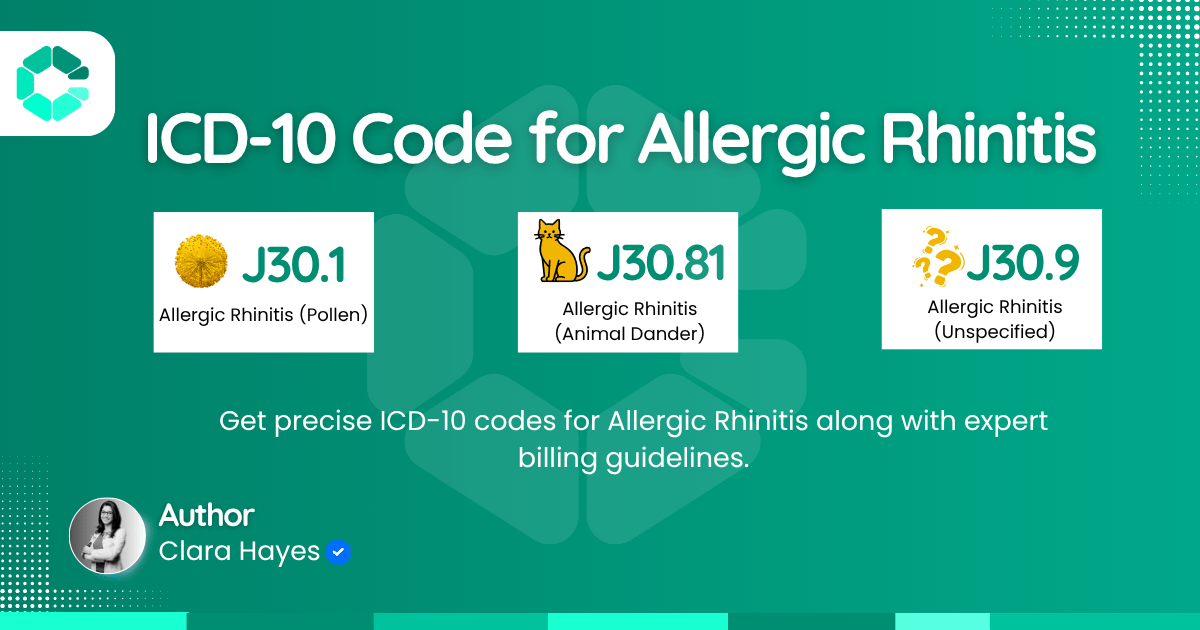
The main ICD-10 code for allergic rhinitis is J30.9 (Allergic Rhinitis, Unspecified ). Coders should use more specific codes within the J30 category when a specific allergen is named (eg, pollen, animal dander) in order to get the best reimbursement and clinical accuracy.
Complete List of Allergic Rhinitis ICD-10 Codes (Category J30)
Accuracy in medical billing starts with selecting the most granular code available. Category J30 covers various forms of rhinitis caused by external allergens.
➤ J30.1: Allergic Rhinitis Due to Pollen
Commonly known as Hay Fever, this code is used when the inflammation is triggered by pollen from grasses, trees, or weeds.
➤ J30.2: Other Seasonal Allergic Rhinitis
Use this code for seasonal allergies not clearly tied to pollen. Use it when symptoms happen at the same times each year. For example, allergies caused by seasonal molds.
➤ J30.5: Allergic Rhinitis Due to Food
Use this code when food allergens a patient ate cause nasal symptoms, not particles the patient inhaled.
➤ J30.81: Allergic Rhinitis Due to Animal Hair and Dander
This code applies to patients with sensitivities to pets or other animals. Documentation should ideally mention the type of animal (cat, dog, etc.) to support this selection.
➤ J30.89: Other Allergic Rhinitis
Use it when you know the allergen, like dust mites or certain chemicals. It does not fit the pollen, food, or animal categories.
➤ J30.9: Allergic Rhinitis, Unspecified
This is a “catch-all” code. While J30.9 is still valid, using it often may trigger insurer audits. This can happen if notes show the provider knew a more specific cause.
Clinical Documentation Requirements for J30 Codes
Clinicians need to include key details in their charting. This helps them avoid a generic summary. It also helps keep their claims accurate. Specifically, provide the following details so coders can assign a code beyond the unspecified code (J30.9).
- → Allergen – The allergen should identify the type of allergen e.g. pollen, dust, dander, food & etc
- → Seasonality – Indicate whether the allergy is seasonal or perennial (does it last all year long or only during certain seasons).
- → Associated Symptoms – Indicate whether there are any cough, eye irritation, rash or etc).
- → Test Results – Provide skin prick test or IgE blood test results that confirm the presence of an allergen.
Coding Scenarios: How to Select the Right Code
Choosing a code isn’t just about finding a match it’s about reflecting the patient’s exact condition. Let’s look at three common scenarios you will face in daily coding:
➤ Scenario 1: The Seasonal Sneezer
→ The Case: A patient visits the clinic complaining of “hay fever” every spring when the trees bloom.
→ Your Action: Use J30.1 (Allergic rhinitis due to pollen).
→ Why: Since the provider identified a seasonal trigger (pollen), J30.1 is your most accurate choice. Avoid using the generic J30.9 here.
➤ Scenario 2: The Pet Lover’s Struggle
→ The Case: A patient develops a runny nose and itchy eyes whenever they are around their cat. The doctor confirms an allergy to animal dander.
→ Your Action: Use J30.81 (Allergic rhinitis due to animal hair and dander).
→ Why: This code adds a layer of specificity that helps insurance companies understand the exact cause of the encounter.
➤ Scenario 3: Multiple Triggers
→ The Case: A patient has allergies to both dust mites and mold.
→ Your Action: Use J30.89 (Other allergic rhinitis).
→ Why: When the allergy doesn’t fall under pollen or animal dander but the provider still identifies a specific cause like dust or mold J30.89 is your go-to code.
Official ICD-10 Coding Guidelines & Rules
To keep your clean claim rate at a high level, it is important to follow the official instructions in the ICD-10-CM manual.
➤ Excludes1 notes related to J30
The Excludes1 note indicates that the code referenced should not be reported with the code listed. You would not report a code from J30 at the same time as J45.909 for asthma and allergic rhinitis.
The asthma code with an allergic component usually takes precedence over J30 codes. Or, follow the specific guidelines for combination coding. In addition, J31.0 is for non-allergic vasomotor rhinitis, and thus it is not the same clinical condition.
➤ Excludes2 notes
An Excludes2 note shows that the referenced code is not part of the J30 code series. However, the patient may have both conditions. As long as you document both conditions, you may report both codes.
Examples of conditions that may be billed with the J30 code include upper respiratory infections (J00–J06). These conditions have an Excludes2 code. They also include chronic sinusitis (J32.-).
Related Conditions & Cross-Coding
Patients with allergic rhinitis often present with comorbidities. Proper cross-coding ensures the full complexity of the patient’s health is captured.
➤ Chronic Rhinitis (J31.0)
Used when the inflammation is long-term but not necessarily triggered by an allergen.
➤ Chronic Sinusitis (J32.x)
Often a complication of untreated allergic rhinitis. You must specify the sinus involved (maxillary, frontal, ethmoid, or sphenoid).
➤ Allergic Asthma (J45.909)
Many patients suffer from “one airway” disease. If the patient has both, ensure the documentation supports the link between the allergy and the bronchial constriction.
Common Billing Mistakes & Claim Denials to Avoid
In the realm of revenue cycle management (RCM), accuracy is a form of currency. Incorrect code use is one reason claims get denied. For example, don’t use a vague code for “cat allergies.”
Use a code that names the allergen. If the notes say “cat allergies” and the biller submits code J30.9 for allergic rhinitis, the insurer may deny the claim. The insurer may also audit the claim.
Code J30.81 may be needed to show medical necessity for specialty treatment, like immunotherapy. To prevent denials:
→ Match acuity: The code should accurately represent the specific allergen documented in the evaluation.
→ Check for overlapping codes: Don’t bill both seasonal and perennial rhinitis in one case. Only do so if notes support each condition separately.
→ Update for 2026: Make sure your billing system includes the most current ICD-10-CM changes for each year.
Common CPT Codes Linked to Allergic Rhinitis
When someone is diagnosed with a condition, the diagnosis code must link to a specific CPT code. This documents the service provided.
Allergy treatment codes start with the “J30 series.” These codes identify people with allergic rhinitis. This condition can be treated with allergy testing and allergy shots (immunotherapy).
You can use the following CPT Codes with patients diagnosed with allergic rhinitis:
→ CPT Code 95004:Used to perform allergy scratch, puncture, or prick tests on patients. These are percutaneous skin tests. They use allergens like pollen or animal dander.
→ CPT Code 95024: Used for the administration of allergy testing by an intradermal injection when the scratch test was negative for a specific allergen, but there is still a clinical suspicion of an allergy.
→ CPT Codes 95115 and 95117: Used to bill for the administration of allergy shots/immunotherapy (95115 for administration of one allergy shot; 95117 for administration of two or more allergy shots).
Pro Tip: Always keep clear records that link the allergen tested (95004) to the diagnosis code (J30.1) on the claim form.
Compliance Tips: Stop Denials Before They Happen
→ “Unspecified” is a red flag for payers in Medical Billing, To help ensure your claims for Allergic Rhinitis (J30.9) get paid on the initial submission, follow these compliance tips.
→ Avoid J30.9 (Allergic Rhinitis, Unspecified): This is a valid code but is often denied by insurance carriers if the clinical notes indicate a specific cause for the allergic rhinitis. Dig deep into the provider’s notes to see if you can determine a more specific diagnosis.
→ Watch for the Excludes1 Notes: ICD-10 has strict guidelines. For example, you cannot use J30.0-J30.9(Allergic Rhinitis) with J00 (Common Cold). If the patient has an acute infection, the rules change. Always check the Excludes1 notes in your coding manual for these reasons.
→ Document the Why: The provider’s documentation should clearly indicate the symptoms (i.e., sneezing, congestion, etc.) that are clinically linked to an allergen. If there is no clear link between the patient’s symptoms and the allergen, the claim will likely be flagged as non-medically necessary.
→ Include Chronic Conditions: If the patient has asthma, make sure the coder documents the asthma diagnosis separately. Documenting both conditions provides a clearer picture of the patient’s complexity.
Demonstrating Medical Necessity for Allergic Rhinitis
Insurance companies and Medicare Administrative Contractors (MACs) rely heavily on Local Coverage Determinations (LCDs) to dictate whether a procedure is covered. Medical necessity is the backbone of these policies.
When a provider bills for expensive, ongoing treatments like immunotherapy (allergy shots), it can be a red flag. Using the unspecified code J30.9 is another red flag. Payors expect that by the time a patient is receiving immunotherapy, the exact allergen has been identified.
Using J30.9 for these claims will frequently result in a “Not Medically Necessary” denial. To guarantee reimbursement, billers must use precise codes like J30.1 (pollen) or J30.81 (animal dander) to validate the necessity of the specific antigen therapy being administered.
J30 Code Selection Cheat Sheet
Use this quick-reference table to quickly match the clinical trigger to the highest-specificity ICD-10 code.
| Code | Clinical Description | Key Allergen / Trigger |
|---|---|---|
| J30.1 | Allergic Rhinitis due to Pollen | Grass, Trees, Ragweed, Weeds (Hay Fever) |
| J30.2 | Other Seasonal Allergic Rhinitis | Seasonal molds, seasonal triggers excluding pollen |
| J30.5 | Allergic Rhinitis due to Food | Ingested allergens (e.g., dairy, nuts, shellfish) |
| J30.81 | Allergic Rhinitis due to Animals | Cat, dog, or other animal hair/dander |
| J30.89 | Other Allergic Rhinitis | Dust mites, cockroaches, perennial non-animal triggers |
| J30.9 | Allergic Rhinitis, Unspecified | Allergen unknown (Avoid when possible) |
Risk Adjustment Coding Of Allergic Rhinitis
Understanding Hierarchical Condition Categories (HCC) is critical. The health care system is moving to value-based care by 2026. Although J30 codes for isolated allergic rhinitis usually do not map to HCC for risk adjustment. However, allergy-related complications usually do.
Typically allergic rhinitis will co-occur with allergic asthma (J45.909). Asthma being a risk adjustment condition has a significant impact on the patient’s Risk Adjustment Factor (RAF) score.
When the patient’s allergic rhinitis worsens their asthma, clinicians need to document both conditions in the clinical documentation. Proper coding for the patient’s full respiratory burden helps the practice get proper funding. This funding supports the complex, ongoing care of chronic disease.
Audit Defending Your Rhinitis Claims
Submitting the claim is just the beginning; the real challenge is keeping the money you are owed during the audit process. To protect your practice, you must follow very strict compliance regulations:
→ No Cloned Notes: Copying and pasting the same allergy symptoms and assessment for a patient is a clear audit red flag. This applies to the same visit or different visits. Each encounter must show a distinct evaluation with a date that corresponds to the visit.
→ Signature Verification: The provider must electronically sign the allergy assessment before submitting the claim. If the medical record does not include the provider’s signature and date, the J30 diagnosis lacks support.
→ Matching Dates of Service (DOS): Bill the allergy serum or immunotherapy injection on the exact date it was given. The CPT line must match that same DOS exactly. The DOS must be the day the service was performed. The provider should document this with a supporting J30 diagnosis code in the final note.
Frequently Asked Questions (FAQs)
Q1: What is the most specific ICD-10 code for seasonal allergic rhinitis?
A: The most specific code depends on the allergen. Use J30.1 if the trigger is pollen (Hay Fever) or J30.2 for other seasonal triggers like seasonal mold. Avoid using J30.9 (unspecified) if the seasonal nature is documented, as it may lead to reimbursement delays.
Q2: Can J30.9 be billed as a primary diagnosis for allergy testing?
A: While J30.9 is a billable code, many payers (including Medicare) require a more specific diagnosis from the J30.1–J30.89 range to justify the medical necessity of CPT 95004 (Allergy Testing). Always code to the highest level of specificity supported by the clinical notes.
Q3: Is there a specific code for perennial allergic rhinitis?
A: Yes, perennial (year-round) allergic rhinitis is typically coded as J30.89 (Other allergic rhinitis). This code is used when triggers like dust mites, cockroaches, or indoor molds are identified as persistent, non-seasonal factors.
Q4: What are the Excludes1 rules for allergic rhinitis and asthma?
A: According to ICD-10-CM guidelines, J30 category codes have an Excludes1 note for allergic rhinitis with asthma (J45.909). You should not bill them together; instead, use the combination code for allergic asthma to accurately capture the patient’s condition.
Connexus Cure’s Medical Coding Services
Our services help you code claims accurately, bill patients, get reimbursements faster, and reduce denials before processing and approval. Contact us now, and we will work with you on improving all your billing and claims processes!
Read More Articles
Explore more ICD-10 coding guides below:
- ➤ Credentialing Guide
➤ICD-10 code for wound care
➤ ICD-10 code for anxiety - ➤ICD-10 code for abdominal pain
➤Icd-10 code for hyperlipidemia
➤Icd-10 code for deviated nasal septum
These articles provide in-depth ICD-10 coding explanations, documentation requirements, and billing insights to help healthcare providers maintain accurate medical records and improve insurance claim success rates.